
Criminal Court Records in Le Flore County
A criminal court record is the case file the Court Clerk opens the moment a charge is filed in District Court. It is not the same as a jail booking sheet. The file follows the case from start to finish. It gathers the charging document, the defendant's plea, bond terms, every motion, each hearing date, and the order that closes the case. The Court Clerk keeps this record for the criminal division of the Le Flore County District Court. For the booking side of an arrest, the jail roster sits with the Le Flore County inmate records, while the filed counts themselves get a closer look on the court charge records page.
Criminal cases in Le Flore County are District Court matters. The District Court is the state trial court, and its judges hear both felony and misdemeanor cases. Felony files carry the prefix CF, and misdemeanor files carry CM. Other criminal labels you may see include Criminal Probable Cause, Criminal Proceedings - Not Filed, and Search Warrants. City code and city traffic matters are not in this file. Those run through the Poteau or Heavener municipal courts and stay outside the county case system.
How to Search Le Flore County Criminal Court Records
Two free state systems carry Le Flore County District Court cases. The Oklahoma State Courts Network offers a case number lookup with Le Flore County District Court in its court dropdown. On Demand Court Records lists Leflore as a selectable court and lets you filter by case type, such as Criminal Felony Proceedings or Criminal Misdemeanor Proceedings. Either one is a good first stop for a name or case number.
- Open the OSCN docket search or the ODCR court search in your browser.
- Pick Le Flore County District Court, then enter a defendant name in last, first form or a full case number.
- Narrow the result by case type and filing year to cut down a long list of names.
- Open the case to read the docket, the listed charges, and the disposition line.
- Ask the Court Clerk for a certified copy when you need a file for legal use.
The online systems show recent and active cases best. Older, paper, or sealed files may not appear at all. When a case is missing, call the Court Clerk at 918-647-3181 to ask about paper records and copy rules. For a statewide criminal history rather than a single county case, the District Attorney page links the OSBI CHIRP service, which checks records across Oklahoma.
Stages of a Le Flore County Criminal Case
A criminal case moves through set steps, and each step leaves a mark in the record. The docket grows as the case advances, so the entries read like a timeline. Reading them in order tells you where the case stands and how it ended. Most felony files also pass through a preliminary hearing, where a judge decides if there is enough cause to send the case forward.
Case flow: Charges Filed › Arraignment › Pretrial / Motions › Plea or Trial › Disposition › Sentencing
| Stage | What Happens |
|---|---|
| Arraignment | The defendant first appears, hears the charges, and enters a plea. Bond terms are often set here. |
| Pretrial / Motions | Lawyers file motions, share evidence, and argue points of law. Hearing dates are added to the docket. |
| Plea or Trial | The case ends in a plea, or it goes to trial where a judge or jury weighs the proof. |
| Sentencing | After a guilty plea or verdict, the judge orders the sentence, fines, costs, and any probation terms. |
What a Le Flore County Criminal Court Record Shows
An open case page packs in many fields. Some name the people involved. Some track money owed. Others mark how the case ended. The list below maps the main fields you will see on a Le Flore County criminal file and what each one tells you. Bond, fine, and cost balances often sit near the bottom of the docket, along with any payment plan status.
| Field | What It Shows |
|---|---|
| Case Number | The unique court ID, such as a CF or CM file with a year and sequence. |
| Defendant | The person charged, listed with the case caption and the filing party. |
| Charges | Each count as filed, with the statute, the level, and any later amendment. |
| Plea | The formal response to each charge, such as guilty, not guilty, or no contest. |
| Disposition | How each count ended: convicted, dismissed, acquitted, or deferred. |
| Sentence | The punishment ordered, including jail or prison time, probation, fines, and costs. |
Who Files Le Flore County Criminal Charges
The District Attorney decides whether an arrest turns into a court case. Le Flore County sits in District 16, led by District Attorney Kevin Merritt, whose office serves both Le Flore and Latimer Counties. The DA can file the charge, decline it, amend it, or reduce it. That choice is why a booking allegation and a filed charge do not always match. The full set of filed counts and their later changes appears on the court charge records page.
The District 16 page from the Oklahoma District Attorneys Council lists the Poteau office and several tracking tools. It links OSCN case tracking, the OSBI CHIRP criminal history service, the Oklahoma Department of Corrections offender lookup, and VINELink for custody alerts. Those links help a victim, a family member, or a researcher follow a case after it is filed. The office also handles bogus check, restitution, and supervision payments tied to its cases.
Charges vs. Convictions
Being charged is not the same as being convicted. A criminal court record can show charges that were later dropped, dismissed, or that ended in a not guilty verdict. A charge is only an accusation. A conviction is a finding or plea of guilt entered by the court. Read the disposition line before you draw any conclusion about a case.
| Charge | Conviction | |
|---|---|---|
| Stage | Accusation | Verdict or plea |
| Burden of Proof | Probable cause | Beyond reasonable doubt |
| Public Record | Yes | Yes |
Reading Le Flore County Dispositions and Sentences
The disposition is the heart of a closed case. It states how each count ended and what the court ordered next. A few terms come up again and again in Oklahoma files. Knowing them helps you read a docket without guessing.
- Conviction
- A finding or plea of guilt entered by the court on a charge.
- Dismissed with prejudice
- The count is dropped and generally cannot be refiled.
- Dismissed without prejudice
- The count is dropped but may be refiled if the law allows.
- Deferred sentence
- Judgment is delayed while the defendant meets set conditions; success can lead to dismissal.
- Probation
- A supervised sentence served in the community instead of full custody.
- Restitution
- Money the court orders a defendant to pay back to a victim.
Note: An online balance of zero does not always mean a case is fully closed, so confirm any open warrant or condition with the Court Clerk.
Defense Counsel in Le Flore County Criminal Cases
A defendant who cannot afford a lawyer may qualify for appointed counsel after a judge reviews need. In Le Flore County, that work runs through the Oklahoma Indigent Defense System. The OIDS Le Flore coverage page lists a Poteau satellite office for non-capital trial work at 507 Dewey Ave, Poteau, OK 74953, with phone 918-647-3907. Appointment of counsel shows up in the docket as part of the case record.
The lead-in image below comes from that official coverage page.
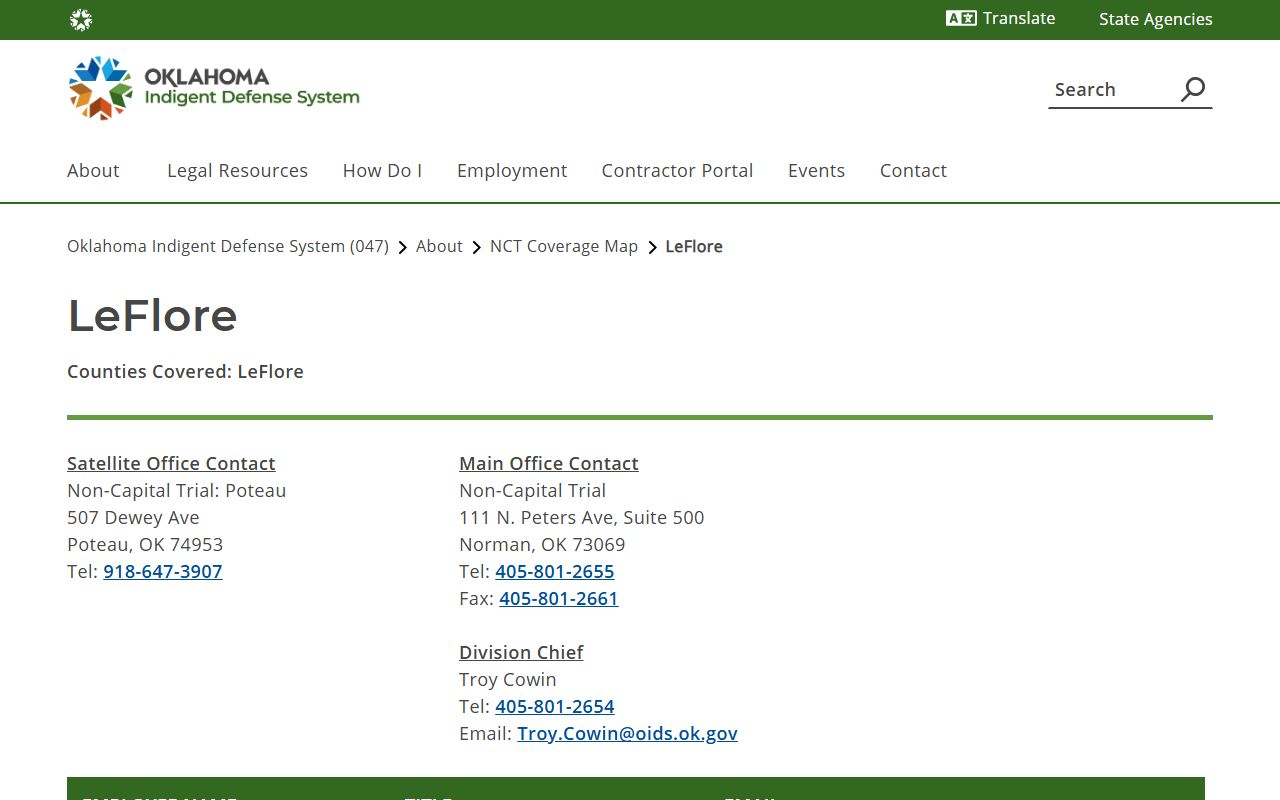
The page names the local satellite and its staff, which is why an appointed defense lawyer in a Poteau case often works out of that office. When a record shows a public defender or court-appointed attorney, this is usually the source.
Oklahoma Indigent Defense System
OIDS is the statewide agency that handles indigent defense outside the largest metro counties. Its mission is to give people who cannot pay legal help that compares with what paying clients get, and to do so at a fair cost. The agency context matters for Le Flore County readers because the local office is one node in a larger system.
The view below is from the OIDS agency homepage.
You can reach the broader agency through the Oklahoma Indigent Defense System page, which gives the mission and statewide contact details. For a Le Flore case, the Poteau satellite remains the first local point of contact.
Sealed vs. Expunged Criminal Records
People often mix up sealing and expungement. They are not the same. A sealed record is hidden from public view but still exists. An expunged record is treated as if it never happened for most purposes. Oklahoma sets eligibility for both in Title 22, and the rules are detailed.
| Sealed | Expunged | |
|---|---|---|
| Visibility | Hidden from public | Destroyed or treated as never existed |
| Law Enforcement | Limited access | Very limited |
| Eligibility | Deferred sentences and certain case types under 22 O.S. §§ 991c and 19 | Categories set in 22 O.S. § 18, reviewed case by case |
The OSBI expungement guide explains the path. Multiple arrests in one county can go on a single petition, but separate counties need separate petitions. The OSBI cannot pre-approve eligibility, and the State can object even when a person qualifies. After OSBI receives a certified copy of the order, the expungement of court and arrest records usually takes about one month, plus the required arrest-record fee.
After a Le Flore County Sentence
The court record does not end the story once a sentence is ordered. A person sent to state prison moves into the custody of the Oklahoma Department of Corrections. You can confirm that status through the Oklahoma DOC offender lookup. The DOC notes that its data is abbreviated and is not a full explanation of a sentence, so the court file remains the better source for case detail.
Victims and family members can track custody changes with VINE for Oklahoma, a free notification service. It alerts users to release, transfer, and other custody events. Paying a fine or cost online does not recall a warrant on its own, and posted payments may take 24 to 48 hours to show, so always confirm a status with the Court Clerk.
Federal Charges vs County District Court
Not every criminal case in the area is a county matter. Federal crimes are prosecuted in the United States District Court for the Eastern District of Oklahoma, which covers 26 counties, including Le Flore. These cases are separate from the county District Court file and are not found through OSCN or ODCR. Federal records run through the PACER system instead.
The screen below comes from the federal prosecutor's official page.
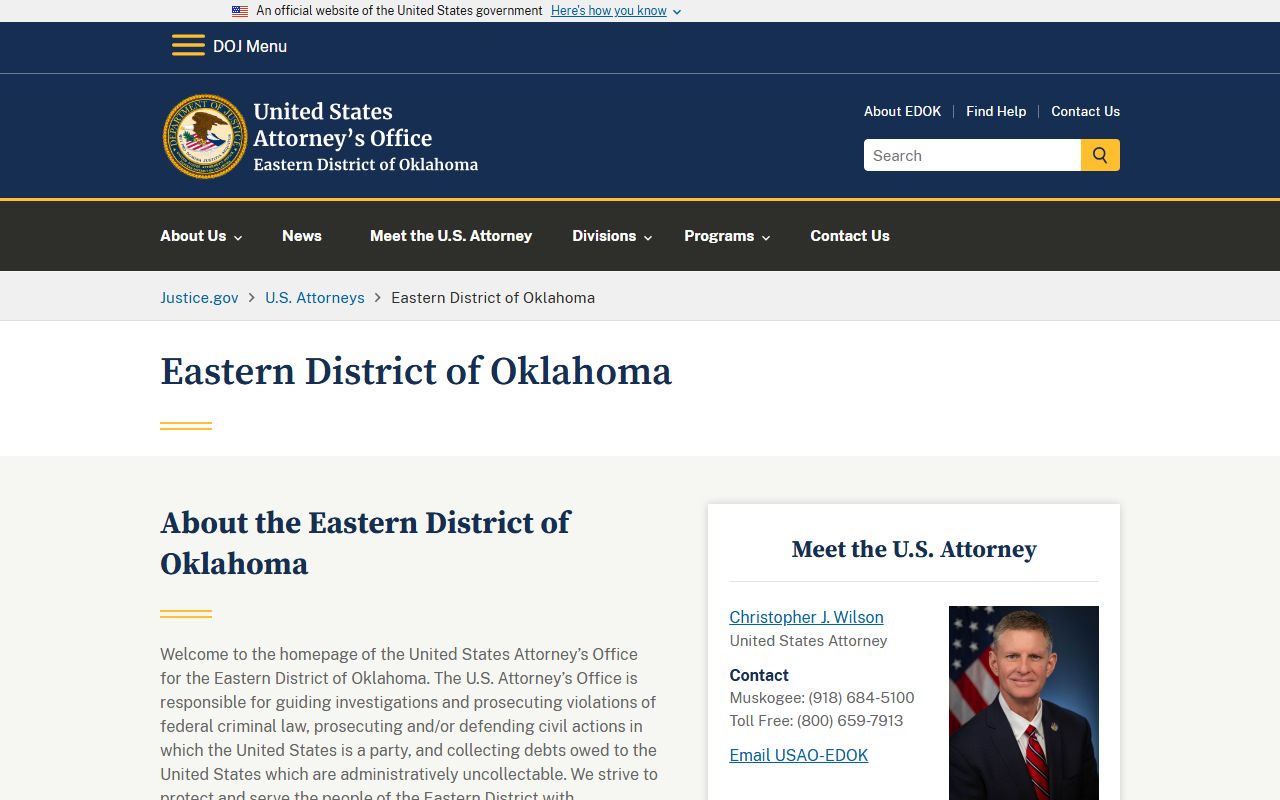
The U.S. Attorney's Office for the Eastern District of Oklahoma handles federal prosecutions in the region. If a Le Flore County case involves a federal charge, look there rather than in the county case system, since the two record streams do not overlap.
Public Access to Le Flore County Criminal Court Records
Oklahoma law treats most court and law-enforcement records as open to the public. The Open Records Act sets the baseline: records stay open unless a specific law or court order makes them confidential. That is why adult criminal case files are generally searchable by anyone. For all record types beyond criminal cases, the broader rules sit on the main court records page.
Key Statutes:
Oklahoma Statutes § 51-24A.5 - Records are open for public inspection unless a specific confidentiality law applies.
Oklahoma Statutes § 51-24A.8 - Sets which law-enforcement records, such as arrest and incident records, must be made public.
Background Check Considerations
A casual case lookup is not the same as a formal background check. Hiring, housing, and credit decisions fall under the Fair Credit Reporting Act, which sets strict rules for regulated screening. A public docket search does not meet those rules. For a legal or employment decision, use an FCRA-compliant provider and verify each fact against the certified court file from the Court Clerk.
Important: This site is not a consumer reporting agency under the FCRA, and its records cannot be used for hiring, housing, credit, or any other FCRA-regulated purpose.
Restricted Criminal Court Records in Le Flore County
Some criminal records stay out of public view even though the case is real. Juvenile records carry strong confidentiality under Oklahoma's juvenile code, so access is usually limited to parties, attorneys, and authorized agencies. Sealed and expunged files drop out of public search by court order. Mental health and certain protected matters may also be closed.
Active cases can be limited too. Some documents are gated or held back by court controls while a case is pending, and personal identifiers such as full birth dates and account numbers are often redacted. If a record you expect is missing, it may be sealed, juvenile, non-digitized, or simply older paper. The Court Clerk at 918-647-3181 can tell you which path applies and whether a certified copy is available. For an active arrest concern tied to an open warrant, the Le Flore County warrant records page covers the next steps.